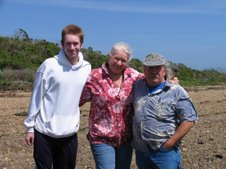
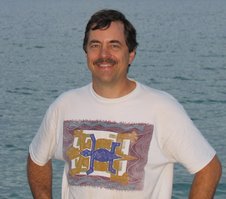
Robin was on the United States walk and helped beforehand with mailouts. She was 20 years old during the walk and a college student at Florida State. She currently lives in Brattleboro, VT and works as a certified substance abuse prevention consultant, community organizer and a media literacy educator. She is still active politically, especially around the impact of media on public health and democracy. She is married to Breeze and she has a stepson named Silas who is heading off to college. Her main passion is belly dancing. "I was a sociology student at the time of the walk. Being on the walk gave me a real life experience in sociology and community. I had the book knowledge but I hadn't lived in a community before so I had a lot of lessons to learn and I still apply some of those lessons today. One of my biggest impacts from the walk is that I gained a huge appreciation for the natural beauty in this part of North America."
"There is so much to say about the walk.... the personal relationships, the day to day logistics of travelling, camping out, cooking, bathing, conflicts, healing, singing. There were powerful experiences of being with the native people and how these different cultures did exist and do exist. I think most of us grow up thinking that one way was the norm and it isn't. Working now with the government, I feel we are more aware of how the services we provide need to be geared toward the culture of those receiving the services whether it's low income families, racial diversity or gender differences. It's all a part of cultural competency. Because of the walk experience, I can now apply that a bit more.
"I've had no desire to go to high school and college reunions, but going to the walk reunions has helped me to keep alive the experience, the stories, the successes, the challenges and the beauty of community. Because we live in a media-saturated society we have to keep these stories alive, we need to tell stories that preserve our planet and not just the stories that our media culture attempts to sell us. Understanding this has helped me to understand the importance of story telling in all cultures and how we have to use our privilege to help others maintain their ability to speak! Dougs book, his tour, the reunions, these have been such great gifts. May we all cross paths again!"
Wednesday, June 27, 2007

Mindi Bender--"I still feel the walk"
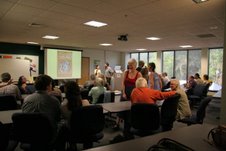
We had a wonderful program in Brattleboro last night, the gathering organized by walk veteran Robin Rieske. More than 50 people showed up. Robin had publicized the event in the local newspapers and Janisse Ray, an old friend and noted writer, wrote a good review of the book for the main newspaper. I enjoyed meeting many warm people including Woody, a Lakota/Dakota Native American. He knew some of the Native Americans depicted in my powerpoint such as Shorty, our guide through the Pine Ridge Reservation. I enjoyed all the hugs afterwards.
This morning, I talked with Mindi Bender, veteran of the U.S. and European walks and long time friend. She currently lives in Ann Arbor, Michigan, and works as a teacher of high school students with special needs. "I recall the great amount of diversity of the people on our walk, the people we met and the vastness of our country's land--the diversity of natural landscape. I wish that I could go back and experience it with my current perspective of being more present, with all the different individuals in different situations, being more involved at a deeper level. All of the phenomenal things we went through were part of our daily lives and I took it for granted that walking was just another way of life. Now I realize how phenomenal our journey was. I learned to be able to accept all kinds of different opinions and be more tolerant.
I loved being immersed in the sacredness of nature all of the time. I continue to seek nature to rejuvenate myself in times of stress and peace.
"Sometimes when I'm walking on paths of nature, I still have the perspective of looking for places to sleep or camp, like when I was on the walk. It's just a natural part of my mind now. With gratitude I honor the four directions when entering and leaving a space in nature. When I walk I still feel the energy coming from my chi center; I still have a fast walking gait, remembering walking 20 miles a day. Even when I walk down the corridors of my high school I think of the rivers and roads and various landscapes that we traversed. I still feel the walk in my body even when I walk through a hallway. I imagine walking the long distances from mountain to mountain. When I'm in a large city I try to seek out the natural spots. When I look at the stars I am reminded of the brightness of the stars in Nevada. The friendships I've made with the core group of walkers have continued and have been maintained through visits and reunions. They are so precious to me. These are the people with whom I love to hike, camp, and travel with in natural areas."
This morning, I talked with Mindi Bender, veteran of the U.S. and European walks and long time friend. She currently lives in Ann Arbor, Michigan, and works as a teacher of high school students with special needs. "I recall the great amount of diversity of the people on our walk, the people we met and the vastness of our country's land--the diversity of natural landscape. I wish that I could go back and experience it with my current perspective of being more present, with all the different individuals in different situations, being more involved at a deeper level. All of the phenomenal things we went through were part of our daily lives and I took it for granted that walking was just another way of life. Now I realize how phenomenal our journey was. I learned to be able to accept all kinds of different opinions and be more tolerant.
I loved being immersed in the sacredness of nature all of the time. I continue to seek nature to rejuvenate myself in times of stress and peace.
"Sometimes when I'm walking on paths of nature, I still have the perspective of looking for places to sleep or camp, like when I was on the walk. It's just a natural part of my mind now. With gratitude I honor the four directions when entering and leaving a space in nature. When I walk I still feel the energy coming from my chi center; I still have a fast walking gait, remembering walking 20 miles a day. Even when I walk down the corridors of my high school I think of the rivers and roads and various landscapes that we traversed. I still feel the walk in my body even when I walk through a hallway. I imagine walking the long distances from mountain to mountain. When I'm in a large city I try to seek out the natural spots. When I look at the stars I am reminded of the brightness of the stars in Nevada. The friendships I've made with the core group of walkers have continued and have been maintained through visits and reunions. They are so precious to me. These are the people with whom I love to hike, camp, and travel with in natural areas."
Tuesday, June 26, 2007
Massacusetts/Vermont events and walkers--Eric Herminghausen
Cyndi and I drove to Greenfield, Massachusetts, where we gave a program at a community non-denominational church. It was organized by Suzanne Carlson, veteran of the United States walk and an ardent peace activist for most of her adult life. We had a warm sharing. The minister approached me afterwards and said he appreciated the quiet sense of hope in my message. Then we drove to Brattleboro, Vermont, where we had a mini-reunion with several walkers.
I talked with Eric Herminghausen, veteran of the United States Walk for the Earth. Eric left the walk group in Durango, Colorado, and walked alone across the country and met up with the group outside of Washington D.C. He now lives in Burke, Vermont. "The walk was passing through the country faster than I wanted so I wanted to get a better feel for an area as I was going through," he said. "It was an evolving philosophy I had. By the time I hit the Mississippi, however, I was studying my map and trying to figure out how I could reach the East Coast before the winter, so it turned into something worse than what I was trying to get away from. So that was revealing. It turned into sort of a marathon event--walking through the country instead of fully experiencing it.
"I have very vivid memories today of the country and people I met on my own. For instance, in walking through Kentucky I met a young boy and he invited me to come home and meet his family and I ended up camping in their yard for a few days. One thing I discovered was my loner tendencies--not feeling comfortable being with a group. It's still a challenge today, but I appreciate partially what I missed and that is walking with a group and the community. I feel today that the walk people are part of my family. So it's sort of a regret that I separated from the walk."
For the past 18 years he has been holding the same job as the caretaker for an historic estate and trying to live a simple life respecting the earth. He built a house in the woods using a passive solar design and has been trying to minimize his impact on the planet.
I talked with Eric Herminghausen, veteran of the United States Walk for the Earth. Eric left the walk group in Durango, Colorado, and walked alone across the country and met up with the group outside of Washington D.C. He now lives in Burke, Vermont. "The walk was passing through the country faster than I wanted so I wanted to get a better feel for an area as I was going through," he said. "It was an evolving philosophy I had. By the time I hit the Mississippi, however, I was studying my map and trying to figure out how I could reach the East Coast before the winter, so it turned into something worse than what I was trying to get away from. So that was revealing. It turned into sort of a marathon event--walking through the country instead of fully experiencing it.
"I have very vivid memories today of the country and people I met on my own. For instance, in walking through Kentucky I met a young boy and he invited me to come home and meet his family and I ended up camping in their yard for a few days. One thing I discovered was my loner tendencies--not feeling comfortable being with a group. It's still a challenge today, but I appreciate partially what I missed and that is walking with a group and the community. I feel today that the walk people are part of my family. So it's sort of a regret that I separated from the walk."
For the past 18 years he has been holding the same job as the caretaker for an historic estate and trying to live a simple life respecting the earth. He built a house in the woods using a passive solar design and has been trying to minimize his impact on the planet.
Monday, June 25, 2007
The Tour Continues!
Cyndi and I left Tallahassee June 18th to begin the East Coast book tour. Our first stop was Atlanta, where we stayed with friends Holly and Craig Loveland and their four children. Holly was once a summer camp student of mine and now she is a summer camp teacher as well as a wonderful mother. We connected with folks at the Phoenix and Dragon Bookstore in Atlanta and had a warm gathering at the Dunwoody Nature Center. Holly's brother Paul Ingram drove down from Dahlonega to join us. Paul was on a three-week walk with us through the Pacific Northwest in the late 1990s. He recalled a wonderful memory of when we met with a group of Native American runners on the Quinalt Reservation and they allowed us to run with them for a mile and to carry their feathered staff. The staff had more than a hundred feathers attached to it, given to the group from native groups they connected with.
After visiting with relatives in South Carolina, Cyndi and I drove to the Big Apple. We quickly learned why country people shouldn't drive in New York. It is a bit nerve wracking with aggressive taxi drivers dominating the roads. We parked at the Quest Bookshop in Manhatten, waited until our heart rates returned to normal, and didn't get in the car again until we left. We walked to the United Nations, Central Park and several other gardens and parks. There are some beautiful spots of nature in the city. We met some very friendly people and enjoyed the fact that New York is pedestrian friendly. I gave a talk at the lecture hall adjacent to the bookstore and we had an interesting discussion afterwards. Topics ranged from the little people to the colors associated with the four directions. Now it's on to Massachusetts and Vermont where we will connect with several walk friends.
After visiting with relatives in South Carolina, Cyndi and I drove to the Big Apple. We quickly learned why country people shouldn't drive in New York. It is a bit nerve wracking with aggressive taxi drivers dominating the roads. We parked at the Quest Bookshop in Manhatten, waited until our heart rates returned to normal, and didn't get in the car again until we left. We walked to the United Nations, Central Park and several other gardens and parks. There are some beautiful spots of nature in the city. We met some very friendly people and enjoyed the fact that New York is pedestrian friendly. I gave a talk at the lecture hall adjacent to the bookstore and we had an interesting discussion afterwards. Topics ranged from the little people to the colors associated with the four directions. Now it's on to Massachusetts and Vermont where we will connect with several walk friends.
Thursday, May 3, 2007
Susi Stahl Palmrose, trying to continue the walker way
From Port Townsend, I drove down to Portland to visit with Susi Stahl Palmrose, who was on the United States and European walks. She grew up on an intentional community in Virginia and attended a Quaker high school. She was eighteen years old during the first walk; she turned nineteen on the last day in Washington D.C.. Now, she has three children and a husband. "One time on the walk in the Midwest," she recalled, "I was walking in the rain and it was kind of chilly. On the outside it would look kind of miserable. I saw pity on people's faces when they glanced my way as they were whizzing by in their metal boxes. But I was very happy and very content. I felt there was nothing else I'd rather be doing, a very peaceful feeling. I was right with the world."
"I joined the walk right out of high school so it was my way of stepping out into the world on my own. Everything was sharp and bright and interesting and new. I remember walking in California, I wanted to capture every sight and tell my family about it. And the experience of just walking is a way of being very real, down to the basics and very simple. You're right there on the road or in the mountains and you got there on your own two feet; that was an internal thing for me. I felt like I was not only doing something for my own benefit, but also setting a good example and a good expression for the rest of the world.
"I know now that those experiences that I was having are important to me for the rest of my life because now when I just take a short walk any where, it's almost like I can just tap into my old walker self. So it's more meaningful for me to just take a little walk. The walk formed something of who I am. Now, in my life I like to bike a lot, so I've transferred some of that to the bike. It can become a tiny revolutionary act of sanity in an insane world because you're slowing things down to a pace that's more natural. I think that our pace of life is unnatural and hasn't given anybody a better lifestyle. I like some things about technology, but a lot of it has made our lives more stressful. Just because we have more machines doing our work doesn't necessarily make us happy or give us more time to relax."
After the walks, Susi began to raise a family. She went back to school when her youngest son was old enough to attend kindergarten. "I wanted to help people in some way," she said. "Nursing was a good fit once I learned the philosophy of nursing. I try to help people where they're at and I'm trying to be non-judgemental and compassionate, even when people have destroyed themselves by their own lifestyle choices such as drugs, drinking, smoking and obesity. Those can be the symptoms of the unhealthiness of the earth; the opposite of what the walk stood for. The medical world is almost enabling the unhealthy lifestyle to continue by allowing people to live half sick by simply prescribing medicine or doing medical procedures, but I'm in the medical world. That's the conflict that I'm trying to work out. The challenge is to be unconditionally loving while knowing that people are accountable for their choices. It's not up to me to give them their lessons. It's up to them and God. But I do encourage them to make healthy choices." Susi tries to set a healthy example by riding her bicycle to work.
In raising her children, Susi tries to set a good example. "Angela (oldest child) has said that I'm more peaceful and relaxed than anyone she knows, so I was glad that I'm that way and she sees that. I've raised my children to be concerned about other living things; I think any living thing is just as important as humans. It's all part of the natural balance of things. I've tried to teach my kids that, but it's up to them to decide for themselves and figure out their own ways."
Tomorrow, we plan to do some hiking and we're doing a program for friends in the evening in her living room. Some friends who do not have vehicles plan to take the light rail system to a station that is only a short distance from Susi's house.
"I joined the walk right out of high school so it was my way of stepping out into the world on my own. Everything was sharp and bright and interesting and new. I remember walking in California, I wanted to capture every sight and tell my family about it. And the experience of just walking is a way of being very real, down to the basics and very simple. You're right there on the road or in the mountains and you got there on your own two feet; that was an internal thing for me. I felt like I was not only doing something for my own benefit, but also setting a good example and a good expression for the rest of the world.
"I know now that those experiences that I was having are important to me for the rest of my life because now when I just take a short walk any where, it's almost like I can just tap into my old walker self. So it's more meaningful for me to just take a little walk. The walk formed something of who I am. Now, in my life I like to bike a lot, so I've transferred some of that to the bike. It can become a tiny revolutionary act of sanity in an insane world because you're slowing things down to a pace that's more natural. I think that our pace of life is unnatural and hasn't given anybody a better lifestyle. I like some things about technology, but a lot of it has made our lives more stressful. Just because we have more machines doing our work doesn't necessarily make us happy or give us more time to relax."
After the walks, Susi began to raise a family. She went back to school when her youngest son was old enough to attend kindergarten. "I wanted to help people in some way," she said. "Nursing was a good fit once I learned the philosophy of nursing. I try to help people where they're at and I'm trying to be non-judgemental and compassionate, even when people have destroyed themselves by their own lifestyle choices such as drugs, drinking, smoking and obesity. Those can be the symptoms of the unhealthiness of the earth; the opposite of what the walk stood for. The medical world is almost enabling the unhealthy lifestyle to continue by allowing people to live half sick by simply prescribing medicine or doing medical procedures, but I'm in the medical world. That's the conflict that I'm trying to work out. The challenge is to be unconditionally loving while knowing that people are accountable for their choices. It's not up to me to give them their lessons. It's up to them and God. But I do encourage them to make healthy choices." Susi tries to set a healthy example by riding her bicycle to work.
In raising her children, Susi tries to set a good example. "Angela (oldest child) has said that I'm more peaceful and relaxed than anyone she knows, so I was glad that I'm that way and she sees that. I've raised my children to be concerned about other living things; I think any living thing is just as important as humans. It's all part of the natural balance of things. I've tried to teach my kids that, but it's up to them to decide for themselves and figure out their own ways."
Tomorrow, we plan to do some hiking and we're doing a program for friends in the evening in her living room. Some friends who do not have vehicles plan to take the light rail system to a station that is only a short distance from Susi's house.
Other Walks
Jean, a neighbor of David and Casey Gluckman--my hosts in Port Townsend--came over yesterday evening with books and a video about the Great Peace March of 1986. She was a thru-walker in the nine-month trek from California to Washington D.C. Our discussion the night before had stimulated renewed interest and memories.
The Great Peace March began with a central organizing group, a large budget, and well over a thousand marchers. Overhead was extremely high, however, and logistics for taking care of that many marchers were a nightmare. The central organizing group went bust in less than three weeks, leaving the walkers stranded in the Mohave Desert. But the human spirit can be strong, and much to the surprise of the media and others, most of the walkers reorganized and persevered; they ultimately completed the walk with much fanfare in Washington. The video was well done and inspirational, and afterwards, Jean exclaimed, "It's time to do another walk!"
In that vein, in San Francisco I had learned of another cross country walk being planned. Native American activist Dennis Banks is spearheading the coast to coast trek to begin next spring on the 30-year anniversary of the Native Americans' "Longest Walk." This one will be called the Longest Walk II. The main message of the walk: all life is sacred. To learn more, log onto http://www.longestwalk.org/.
The Great Peace March began with a central organizing group, a large budget, and well over a thousand marchers. Overhead was extremely high, however, and logistics for taking care of that many marchers were a nightmare. The central organizing group went bust in less than three weeks, leaving the walkers stranded in the Mohave Desert. But the human spirit can be strong, and much to the surprise of the media and others, most of the walkers reorganized and persevered; they ultimately completed the walk with much fanfare in Washington. The video was well done and inspirational, and afterwards, Jean exclaimed, "It's time to do another walk!"
In that vein, in San Francisco I had learned of another cross country walk being planned. Native American activist Dennis Banks is spearheading the coast to coast trek to begin next spring on the 30-year anniversary of the Native Americans' "Longest Walk." This one will be called the Longest Walk II. The main message of the walk: all life is sacred. To learn more, log onto http://www.longestwalk.org/.
Wednesday, May 2, 2007
WaHeLut Indian School
I spoke to John's class at the WaHeLut Indian school on Monday. The school was named for a Nisqually warrior and medicine man who resisted white settlement and whose power is said to have flowed from thunder and lightning. John's nine fifth graders were friendly, lively and interested in the walks. Afterwards, the class took outside to their school sweat lodge along the Nisqually River. One girl said she had participated in a sweat ceremony the day before. Another student said he received his Indian name in a sweat ceremony. All of them had participated in a sweat ceremony at one time or another and they knew the main purposes of the ceremony--the purification of mind, body and spirit.
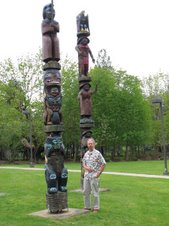
The school itself was immaculate, with totem poles adorning the front entrance and life-sized carvings of what was described as welcoming figures in the main entranceway. A large mural and dugout canoe depicted traditional life along the river. I met the principal and assistant principal and felt very welcome.
That evening, I joined John and his wife Susan in watching eight-year-old Keats Montrose play in a baseball game in the cold drizzle. I was convinced that the game would have been cancelled in normally drier climates. Just after Keats made a clutch hit with bases loaded, the game was stopped when the rain intensified and players were visibly shivering, along with spectators such as the one from Florida.
Now, I am staying with friends in Port Townsend, Washington. We had a neighborhood gathering last night, discussing the walks and other subjects. Overall, Port Townsend is an environmentally friendly community with a large group of people working to reduce their energy useage and "carbon footprint" in an effort to check the advance of global warming. Today, we hope to do some kayaking in Puget Sound.
The school itself was immaculate, with totem poles adorning the front entrance and life-sized carvings of what was described as welcoming figures in the main entranceway. A large mural and dugout canoe depicted traditional life along the river. I met the principal and assistant principal and felt very welcome.
That evening, I joined John and his wife Susan in watching eight-year-old Keats Montrose play in a baseball game in the cold drizzle. I was convinced that the game would have been cancelled in normally drier climates. Just after Keats made a clutch hit with bases loaded, the game was stopped when the rain intensified and players were visibly shivering, along with spectators such as the one from Florida.
Now, I am staying with friends in Port Townsend, Washington. We had a neighborhood gathering last night, discussing the walks and other subjects. Overall, Port Townsend is an environmentally friendly community with a large group of people working to reduce their energy useage and "carbon footprint" in an effort to check the advance of global warming. Today, we hope to do some kayaking in Puget Sound.
Subscribe to:
Posts (Atom)